







Symbolic Nation-Building in Central and Eastern Europe.
„Central and Eastern Europe is far from a grey colour and indistinct shades. Moreover, it has come back to center stage today when a new geopolitical pattern is emerging. The authors of this volume deal with this colourful area in a relatively broad sense: they cover five countries – Slovakia, Poland, Romania, the Republic of Moldova and Ukraine. In the middle of the region, Hungary is also touched on in many of the papers. The authors focus on the struggle for control over space that reflects the complex, often conflictual and contradictory relationship between centres of power and minority communities. Symbolic nationalism practiced in urban spaces produce key events and key sites in these conflicts. The rivalry between national movements, whether it is through or for the various national symbols, takes many forms. This rivalry has been going on for more than two centuries and is likely to continue for some time. This work delves into the recent history of symbolic control over space in the region.”
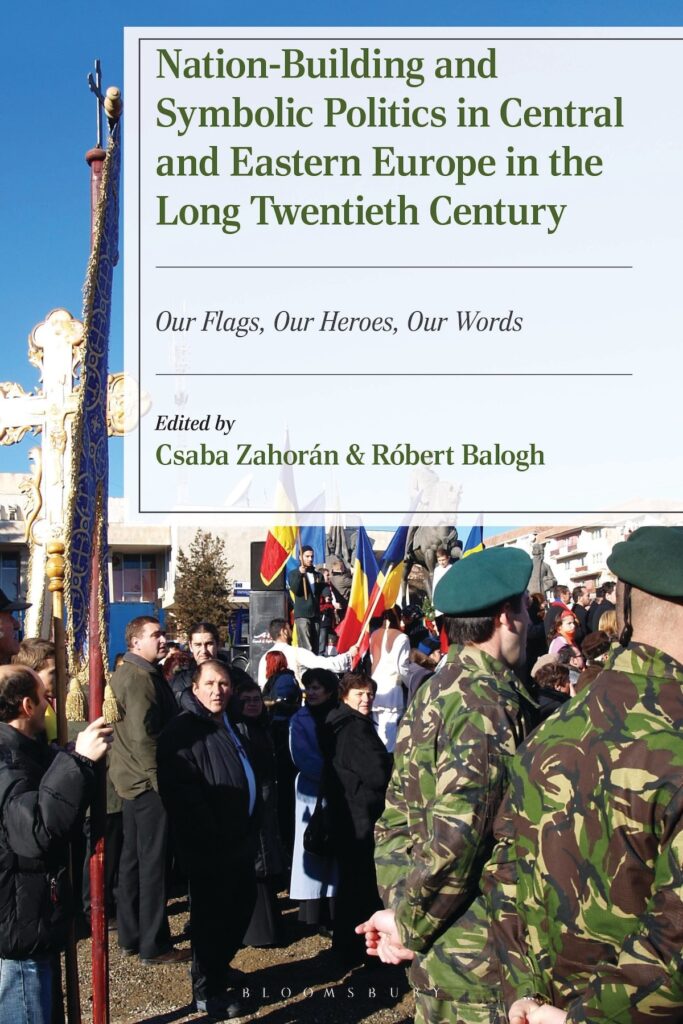
The cover of the book
This is what it says on the back cover of the book, which was recently published by Bloomsbury. The editors of this volume are Csaba Zahorán, a research fellow at our institute, and our former colleague, Róbert Balogh (who currently works at the University of Ostrava.) At the request of an American publisher, back in late 2022, they decided to compile a volume on the symbolic representations of nation-building and memory politics in Central and Eastern Europe throughout the 20th century. As one of the objectives of the Institute of Central European Studies is to strengthen cooperation amongst researchers working in the region and specialising in the countries there, they approached and involved not only colleagues from Hungary but also Hungarian, Romanian, Slovak and Polish experts from abroad in the project. Following the development of the concept, the manuscripts were completed, and the authors then presented their topics to one another at a workshop held at Ludovika University of Public Service at the end of 2023.
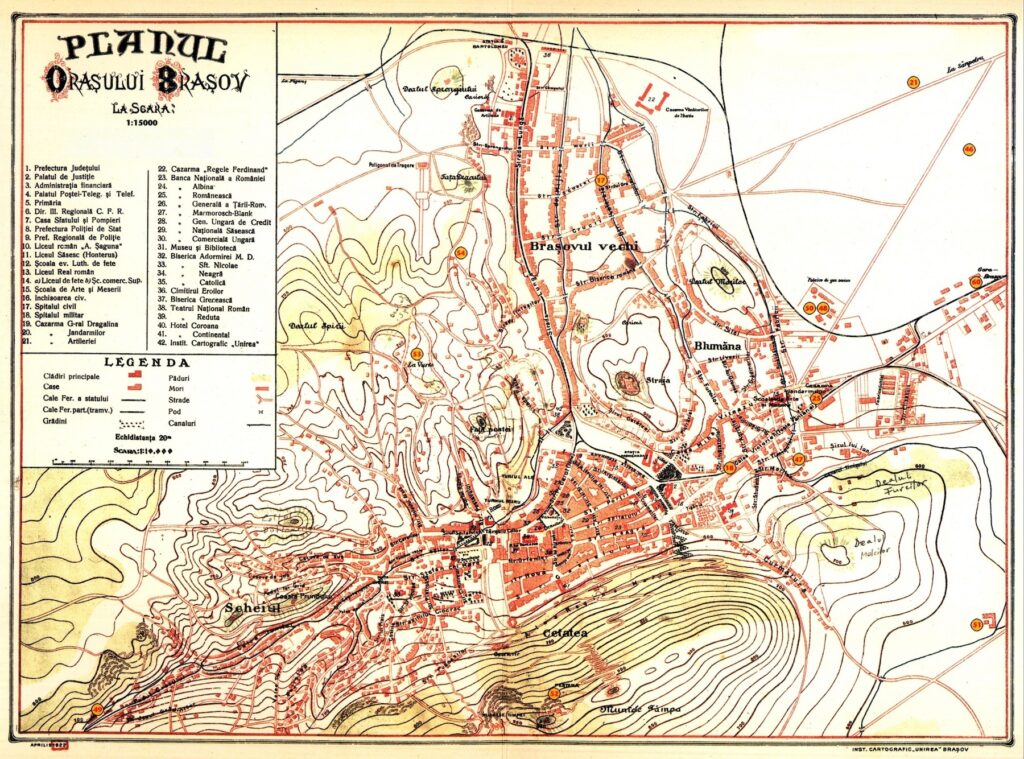
A map of Brașov from 1922. Source: Wikipedia
The volume was finally published in May 2026 (July in Europe), and in addition to the two editors, a further nine authors contributed: mainly historians and political scientists, but also including a geographer, an economist and a lawyer. In chapters that each read like a case study, they have illustrated the processes mentioned above across the period from the second half of the 19th century to the present day. The introduction and regional historical overview by Csaba Zahorán and Róbert Balogh are followed by a walk through the public spaces of Chișinău, during which Zsolt Bottlik and Csaba Zahorán review the modern-era transformations of the Moldovan capital following shifts in power. In the second chapter, Alica Kurhajcová guides the reader to Turócszentmárton in Upper Hungary (now Martin, Slovakia), highlighting the rivalry between Hungarian nation-state building and Slovak nation-building during the era of dualism. In chapter 3, we encounter yet another set of power dynamics: in post-Trianon Transylvania, the Hungarians found themselves in a minority, and Gábor Egry captures the factors that prevented a centrally orchastered Romanian nationalisation in the form of public street names.
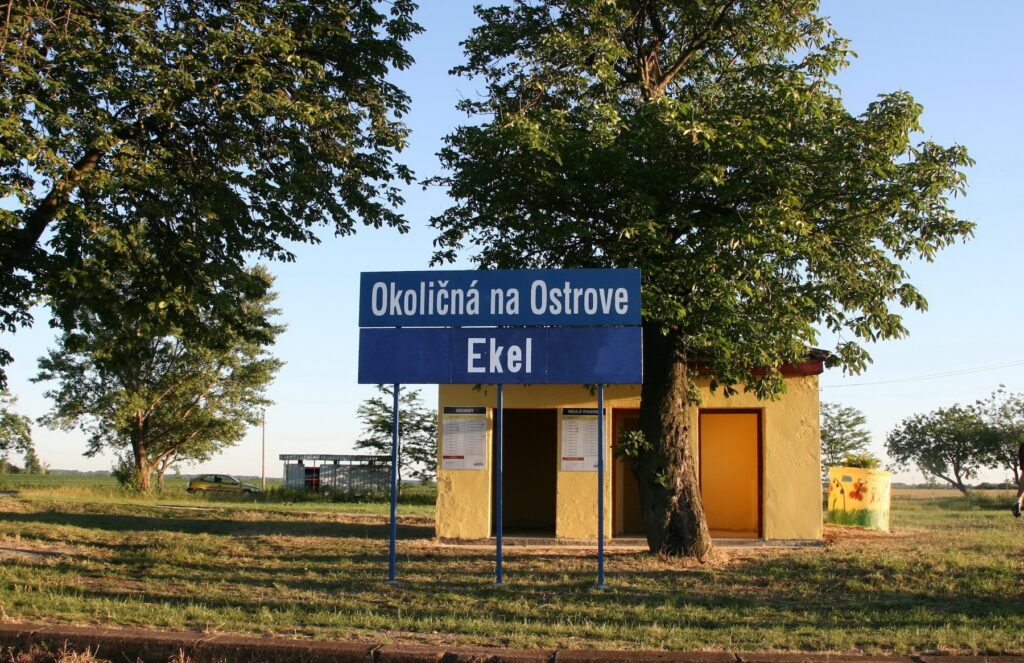
A bilingual sign put up by activists at the railway station in Ekel (Okoličná na Ostrove),
southern Slovakia.
Source: János Fiala-Butora
The study by Dragoș Dragoman and Andreea Zamfira also deals with Transylvania, but this time the focus is on Saxon–Romanian relations. In the fifth chapter, Csaba Zahorán examines how Hungarian and Romanian symbolic politics has led to creation of distinct spaces that ethnic politics attempts to inhabit. János Fiala-Butora’s study describes the efforts made by Hungarian activists and politicians since the change of regime to promote the use of the Hungarian language by Hungarians in Slovakia, with particular emphasis on the activities of the ‘Bilingual Southern Slovakia’ civil movement in the 2010s. In chapter 7, Csilla Fedinec uses the examples of two monuments – the imgainary Turul bird, symbolising the first Hungarian royal dynasty, in Munkács (Mukachevo) and the ‘Mother Ukraine’ statue in Kyiv – to illustrate nation-building in Ukraine during recent wartime and the complex background to the struggles over symbols. The volume concludes with a study by István Kollai and Olga Groszek, in which the authors present to the reader the modern history and ‘imperial heritage’ of two emblematic and buildings in the Slovak and Polish capitals, the Bratislava Castle and the Palace of Culture and Science in Warsaw. The publication, which runs to nearly 300 pages, includes several maps to aid navigation in the region between Germany and Russia, and the text is supplemented by numerous black-and-white photographs.
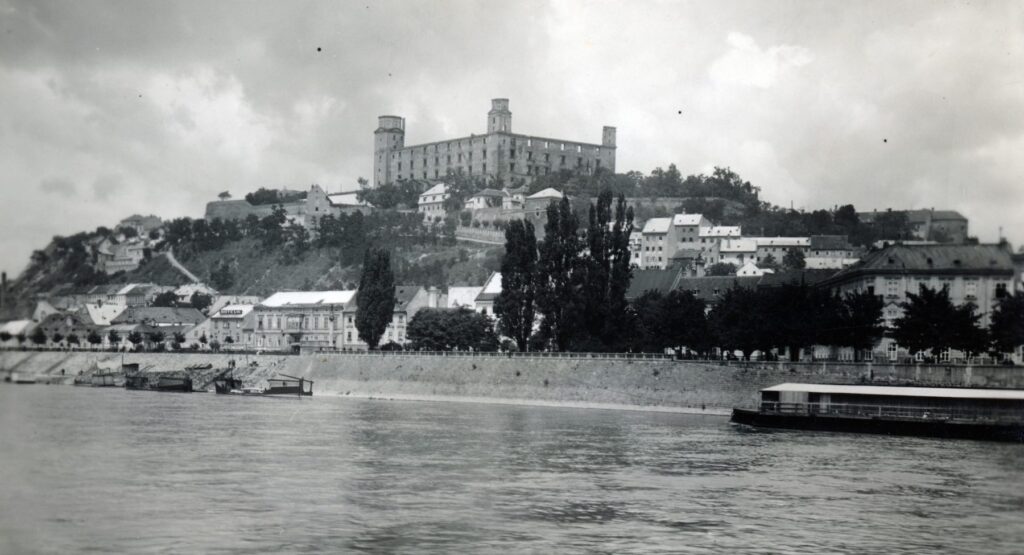
Bratislava with its ruined castle in 1933. Source: Fortepan / Ida Horváth