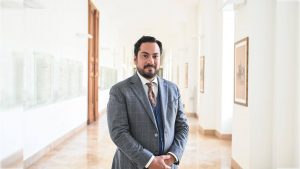

As fellows of the Ludovika Public Diplomacy Hub, Pakistani researcher Mansoor Ahmad Khan and Polish researcher Paweł Pawłowski spent several productive days in Budapest on the Ludovika Campus at the end of last year. In our magazine’s paired interview, we asked these international experts primarily about the focus of their research topics, as well as about collaborations between universities and research centers and the results of such efforts.
First, I ask both of you to introduce yourselves briefly to our magazine’s readers.
M.K.: I am Mansoor Ahmad Khan, a former diplomat from Pakistan. I worked as a diplomat for nearly 33 years in various parts of the world. I served as Pakistan’s ambassador to Austria and Slovakia in Vienna, and I also worked in Pakistan’s UN delegations in Vienna and then Geneva. In addition, I spent a lot of time in my own region, serving four years in India and then six years in Afghanistan. Since retiring, I have been affiliated with a political research center connected to a local university. My work primarily involves participating in research that focuses on political and economic interactions between Pakistan and other countries around the world, facilitating these activities, as well as Pakistan’s key public policy issues, such as climate change, the digital technology revolution, education, artificial intelligence. I am also interested in exchanges of ideas, such as participating in the work of the Ludovika Public Diplomacy Hub.
P.P.: I am Paweł Pawłowski, a Polish researcher who focuses on the legal aspects of combating disinformation. Through my research, I try to find solutions for how we can resist disinformation while preserving our fundamental freedoms. For me, the most important are freedom of speech and freedom of opinion, because we can see that while fighting disinformation, we might undermine the foundations of our social and political systems. I am an assistant professor at the University College of Professional Education in Wrocław, and in addition, I am a member of a research center and foundation that I co-founded, which aims to support cooperation in Central and Eastern Europe. We oppose those ideological projects that are imposed on Europeans, and we are strong advocates of the transatlantic alliance.
What do you think: can reassuring solutions to our existing problems and conflicts emerge through international, close, and honest cooperation between universities and research centers?
M.K.: Our world today is indeed facing serious challenges, conflicts, and tensions. In my view, ongoing exchanges of ideas among universities, research centers, and scholars from different parts of the world can help find solutions to these issues and prepare recommendations for decision-makers. Of course, we don’t have immediate solutions in our pockets, but continuous interaction can help people get closer to each other, and thus to solutions as well. For example, the Ludovika Public Diplomacy Hub fellowship has been a great help for me in gaining a deeper understanding of Hungary’s history, including that of the Ludovika, with the assistance of Hungarian researchers, journalists, and students. Although I had visited here before, it has now become even clearer to me what issues the country is facing, what policies it is pursuing for economic growth, achieving peace and stability, and improving the lives of Hungarian people. I can relate to these myself, as the region where I live faces similar challenges. That’s why it would be good if we could also invite Hungarian researchers to Pakistan to make similar visits and try to get acquainted with our circumstances.
P.P.: The university’s fellowship is a fantastic initiative that supports our efforts in several ways. First, it has helped me better understand Hungary, the Hungarian perspective, Hungarian culture, and Hungarian history, as well as the history of the Ludovika. I particularly liked that at this university, education is not just about the curriculum, but students can build a complex personality alongside it, which includes a patriotic attitude. In addition, the fellowship is a great opportunity to meet Hungarian people who share very similar views to mine and who research in the areas of freedom of expression, as well as media law. I also had the chance to meet those Hungarian experts who are interested in strengthening Central Europe today. Two more elements broadened my perspective at the university: on one hand, the presence of my Pakistani fellow researcher, and on the other, the opportunity to meet Stipendium Hungaricum scholarship students studying at the Ludovika. It was a new and great experience to learn about completely different perspectives and problems through them, as well as a refreshingly new perspective on Europe.
What advice would you give to a Hungarian student or researcher who is more interested in your research areas?
M.K.: Today, we live in a challenging, globalized, interconnected world. Pakistani students know well what is happening in Europe or the United States. Similarly, Hungarian or European students know what is happening in other parts of the world. These students will be the ones who soon step onto the stage in government, business, or other areas of life, meaning they will lead our countries. The most important thing is to have interaction and cooperation between us. If this works, then I believe we can build a better world than today. There is still a lot of potential in this, primarily due to technological development, the digital revolution, and the improvement of international communication. I myself would like to encourage both Hungarian and Pakistani young people to make even better use of the opportunities for mutual communication and getting to know each other.
P.P.: To this student or researcher, I would like to emphasize that while we all valiantly resist and fight against various threats, we must always remember what we are defending. We cannot fight in such a way that, in this battle, we ultimately lose sovereignty or freedom completely. No economic growth is worth the price if we lose our security and identity in the process. In my opinion, it is very important for every young person today to build the awareness that we have values and traditions that we must protect at all costs, and there is no prosperity for which we would throw them away.