


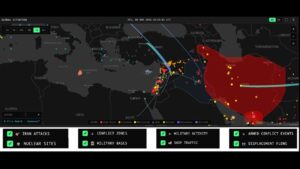



In early March 2026, the Russian-flagged Liquefied Natural Gas (LNG) tanker Arctic Metagaz was rocked by explosions in the Mediterranean, which Moscow has described as a Ukrainian naval-drone attack, though the circumstances remain disputed. Over the same week, NATO air-defence systems intercepted several Iranian ballistic missiles over southern Turkey, with debris falling on Turkish soil. These incidents reflect a broader pattern of rapidly deteriorating security environment across a connected geopolitical space linking the Mediterranean, the Sahel, and the Gulf, one that Italian intelligence services have increasingly described as strategically interconnected, and whose consequences are landing directly on Europe’s shores.
Italy’s 2026 Annual Intelligence Report
Italy’s 2026 Annual Intelligence Report Warns of an Expanding “Arc of Crises” Across the Wider Mediterranean, stretching from the Sahel to the Persian Gulf. The report identifies three interacting dynamics: the escalation of conflict in the Middle East and its risk of spreading terrorism; the fragility of North African states along the Mediterranean migration corridor; and demographic, security, and climate pressures in the Sahel driving northward migration flows.
For the first time, Italian intelligence used generative AI tools to model migration scenarios, projecting arrivals along the Central Mediterranean route at between roughly 42 and 180 migrants per day depending on geopolitical conditions. Libya is identified as the primary departure hub, while Tunisia, Egypt, and Algeria are flagged as alternative routes whose importance may increase if conditions deteriorate.
Pressure across the Mediterranean
In the eastern Mediterranean, the military escalation between Israel and Iran, which intensified sharply since 28 February, brought the conflict directly into NATO territory when three Iranian missiles intercepted with debris falling on Turkish soil.The WHO reported over 1,300 deaths in Iran and more than 570 in Lebanon by 11 March, with 43 confirmed attacks on health facilities across both countries. Lebanon, which hosts the largest refugee populations per capita, continues to face significant displacement pressures, with direct humanitarian and political implications for the wider Eastern Mediterranean region.
In the central Mediterranean, the sinking of the Russian LNG tanker north of Sirte on 4 March marked a geographic shift with the Ukraine-Russia conflict physically entering the Mediterranean sea region. The vessel carried approximately 62,000 metric tons of Liquefied Natural Gas. All crew were rescued, but the episode signals that the Mediterranean is no longer insulated from the war in Eastern Europe.
In the southern Mediterranean, the EU plans to fund a Maritime Rescue Coordination Center in Benghazi, in territory controlled by General Khalifa Haftar beyond the internationally recognised Government of National Unity in Tripoli. While direct EU cooperation with Haftar had long been avoided due to legitimacy concerns, EU Migration Commissioner Magnus Brunner has called for further negotiation with both Libyan forces, signalling a shift in approach. Though Brussels formally recognizes only the Tripoli government, which emerged from UN-mediated political processes, the willingness to engage Haftar’s administration demonstrates how far European migration policy has shifted under pressure, and how the Libyan corridor remains central to EU southern border management strategy.
Recognizing interdependence
Instability in the Sahel, the escalation of hostilities between Israel, Iran, and the United States across the Eastern Mediterranean, and broader great-power competition are increasingly interconnected, with crises demonstrating how distant conflicts produce immediate consequences across the region and beyond. The arc of crises illustrates the fundamental reality that security and stability are indivisible. The stability of all depends on the security of all. Addressing these challenges requires a comprehensive approach that integrates conflict prevention, cooperative security frameworks, peacebuilding efforts, and coordinated policy measures across the entire region.
Photo credit: google maps