








The first international organization covering AI
Just a few days ago, on 17 July 2026 29 heads of state and government have signed the foundational document of the World Artificial Intelligence Cooperation Organization or WAICO in short. While the event itself casually flew under the radar of most media outlets, it marks a landmark moment for artificial intelligence (AI) regulation and at the same time fits very well into Chinese political-diplomatic aspirations on the international level. This short survey aims to discuss what the organization is about, who are the members and which states are absent and finally, how WAICO ties to high-level Chinese diplomacy.
First things first. From the perspective of international organizations, WAICO aims to be a universal and open entity, meaning that it is open to all states seeking admission and only requires abiding by the principles and tenets enshrined in the foundational document. There are a few issues in this apparently seamless and easy-going attitude proclaimed by the nascent organization. First of all, its foundational document is not yet available to the public, so we know precious little about actual admission criteria, structure, budget and related issues. Naturally, it has been circulated among states who have been invited to join in the first round, but not to a wider audience as of the writing of this piece. Secondly, Chinese president Xi Jinping himself declared that organization was created to ‘promote inclusivity in the Global South’ which limits the sphere of potential member states if they feel the organization was not created with them in mind. Then again, it could be seen as a political statement as the ‘Global North’ has a drastically different view on AI and how best to regulate it, therefore such a statement can be perceived as pre-emptively not counting on the ‘Global North’ to join.
In fact, the proclaimed goal of the organization is to enhance cooperation, bridge the technological gap and foster an innovative regulatory framework. While laudable and uncontested, these aims remain somewhat vague. That should not come as a surprise as most international organizations are created with ambitious, long-term agendas that aim to bring a plethora of states to the table while their goals are always open to interpretation depending on the current international political climate. What is worth noting is who these states are that are currently seated at the table in Shanghai. At first glance, it appears as a truly universal initiative with founding states representing four continents but there are some missing areas worth noting. Primarily, that the ‘Western States’ such as the US, all of the EU member states, Japan, South Korea, Australia, New Zealand, etc. are missing. This should not come as a surprise as the US is vehemently against any regulation on AI, instead opting to ‘promote innovation and competition’, and during the tenure of the Trump administrations have successfully dismantled even the sprouting roots of regulation that it previously had.
The EU’s absence can also be explained as it is the organization that adopted the first binding international regulation on AI (EU AI Act) and has opted for a fundamentally different approach to regulate AI that is unlikely to be compatible with WAICO. In this regard, the unity of block is a welcome sight of standing by common values and norms. Even the extended European sphere is missing from the roster as on the level of the Council of Europe, a human-rights based understanding of AI regulation is promoted, especially since the adoption of the AI Framework Convention in 2024. At this point, it should be noted that none of the statements on WAICO discussed human rights save for ‘safe use of AI’ which through some logical acrobatics could be understood as digital human rights but it is quite a stretch to envision it so. From the European theatre, Serbia is present, although this is hardly a shock as the country received substantial financial backing in the form of investments from China and serves as one of the European focal points for its Belt and Road Initiative.
It is apparent, that China also wanted to bring BRICS states to the table which is mostly successful, as Brazil, Russia and South Africa have lent their support, but India is notably missing. This fact can be explained by two factors: firstly, Pakistan is becoming a WAICO member and seeing how Pakistan relied heavily on Chinese weapons during the last armed altercation between the two countries, it has re-kindled Indian enmity against China. Secondly, India follows European regulation closely and looked upon the AI Act as a template to be followed – albeit with locally desirable adjustments. This was apparent with the GDPR and now with the AI Act. Nonetheless, this so-called Brussels-effect of EU regulation extending far beyond the territorial scope of the ‘old continent’ has been somewhat stalled due to the delays in the full implementation of the AI Act.
In Latin-America, besides Brazil as a BRICS state, only Nicaragua, Cuba and Venezuela, the traditionally three most left-leaning states have signalled their willingness to contribute. While on the African continent, a mere 10 out of 55 states have joined which is a surprisingly low number considering the perceived influence of China on the continent and may signal that some countries in the region are taking on a more cautious attitude towards the ‘Dragon’. With that said, states that are quite indebted to China due to major infrastructure projects such as Ethiopia and Kenya had little choice but to repay prior favours by signing up to WAICO.
A major success for China, however, lies in the fact that all Central Asian states – with the persistent exception of Turkmenistan – have signalled their intention to join WAICO. As China has consciously built one if not the strongest and most pronounced prong of its Belt and Road Initiative in the region and increased its influence in Central Asia consistently, this could be expected. Another area seemingly ready to adopt the Chinese outlook on AI is Southeast Asia, where besides Thailand, Singapore and the Philippines, all members of ASEAN have made a representation to Shanghai. Thai absence remains somewhat of a mystery, as diplomatic and economic ties between Thailand and China are at an all-time high culminating in high-level visits, supportive political statements and BYD factories in the country. While Philippine absence can be explained by the two countries has continued standoff in the South China Sea concerning Chinese expansion and the subsequent creation of artificial islands leading to an arbitration process in 2016 ruling in favour of the Philippines.
There is one more point to consider and that it the why – why was it necessary for China to establish WAICO and how does it fit into global Chinese aspirations. Over the last two decades, China has been growing ‘assertive’, meaning it has been able to present and promote its interests more fiercely than before. As some scholars and commentators have put it: ‘the Dragon’s teeth’ can now be seen. This has manifested itself as a more robust presence in the United Nations Security Council such as when a close ally, the Myanmar junta was threatened with sanctions after the violent crackdown on protesters during the aftermath of the 2021 coup d’état, the denial of human rights violations in the case of the Uighurs as well as the myriad bilateral financial, investment and infrastructure agreements between a large number of states – as can be seen by some of the examples above.
This assertive presence can be seen on the level of international organizations as well using a dual approach. In case China felt that it can exert sufficient influence over an existing organization, it opted to do so, as it the quicker, easier and more convenient way since long-standing organizations convey much more prestige and legitimacy to Chinese goals than newly established ones. Prime examples for this approach can be seen in case of the World Trade Organization and the World Health Organization, both of where China has become not only a major financial contributor, but a vocal and enthusiastic support of their work all the while wielding considerable influence over their decisions. However, other organizations are built differently and in the case of financial organizations such as the IMF or the IBRD, Western Powers refuse to relinquish their leading positions. In such cases, China creates its own, parallel institutions, such as the AIIB, the Asian Infrastructure Investment Bank or the NDB, the New Development Bank. It is also a valid tool in the Chinese arsenal to formalize discussions with entire regions such as Africa, Latin-America or the Arab States in order to facilitate negotiations and keep these on the Chinese orbit. WAICO is a somewhat different matter though, as there are no other organizations that would regulate AI. A likely reason why China opted to build an organization from the ground up is because due to the vastly different outlook on AI, it was highly unlikely from the start that a universal – in this case meaning UN-level – organization can be established any time soon. Through an organization led by China, the country could mould WAICO according to its own interests but as we have seen, a major disadvantage lies the reluctance of several states to meaningfully engage with the nascent organization. This can be perceived as the limit of Chinese influence or sensible caution from the side of possible partners. The caution of reluctant states can also be understood as precious little is known as to how WAICO will function. Even leaders such as outgoing UN Secretary-General António Guterres who has promoted a more stringent regulation of AI at the Shanghai Conference, omitted explicit mention of endorsing WAICO even though China has reiterated that the UN Charter will be upheld without reservation during its work. Nonetheless, as a newly established organization, it will first have to prove its worth to members of the international community. As the very first international organization created to regulate AI and harmonize the conduct of states, the task will be mighty indeed.
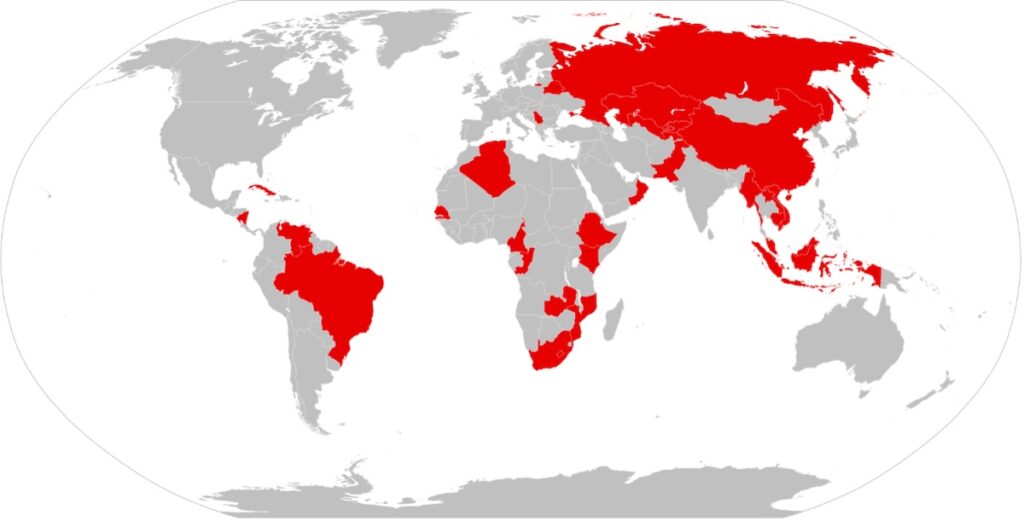
Map source: The Account 2 / Wikimedia.
Note that the Crimean Peninsula erroneously appears as part of Russia
which is an unlawful depiction under international law.
Cover image: View of Beijing from city TV tower, source: fightbegin / depositphotos.com