







Security, Dependency, and Interdependence
Migration has become one of the most persistent and politically sensitive dimensions of Europe’s external relations with its southern neighbourhood. Over the past decade, the Mediterranean has become a space where security, foreign relations, and domestic political pressures intersect, shaping how the European Union engages with North Africa.
In this context, the EU’s migration strategy is no longer defined by isolated agreements. Instead, it increasingly requires institutional cooperation and strategic dependency.
From crisis management to structured Dependency and Cooperation
The EU’s approach to migration in the Mediterranean is gradually shifting toward more institutionalised frameworks of cooperation. This evolution is visible in a growing bilateral partnerships, memoranda of understanding, financial agreements, and high-level political visits involving key transit states, namely Tunisia, Libya, Morocco, Egypt, Jordan, Lebanon, and Syria, where migration management has become a central pillar of the EU’s external relations with its southern neighbourhood.
In July 2023, the EU and Tunisia signed a Memorandum of Understanding covering five pillars, macroeconomic stability, trade, green energy, people-to-people contacts, and migration. European Commission President Ursula von der Leyen described the agreement as a “blueprint” for future arrangements with other regional partners.
In July 2025, the European Commissioner for Internal Affairs and Migration, Magnus Brunner travelled to Libya, alongside officials from Greece, Italy, and Malta, for talks aimed at strengthening Libyan border controls and reducing Central Mediterranean crossings.
In parallel, Morocco’s Foreign Minister Bourita met with Commissioner Šuica and High Representative Kallas in Brussels on the sidelines of the 5th EU Ministerial Meeting with the Southern Neighbourhood, where discussions centred on security cooperation and the Mediterranean Pact. A second high-level meeting followed in January 2026, at the 15th EU-Morocco Association Council, covering migration, the green transition, and the 30th anniversary of the EU-Morocco Association Agreement. Kallas visited Rabat again in April 2026, reaffirming the strategic importance of the partnership in bilateral talks with Bourita.
Beyond formal institutional channels, EU leaders held a working lunch on 24 April 2026, on the sidelines of an informal European Council held in Lefkosia and Agia Napa, Cyprus with key regional partners from Egypt, Jordan, Lebanon, and Syria, signaling the Mediterranean’s growing centrality in EU foreign policy.
Alongside this, the Multi-Annual Measure for Migration in the Southern Neighbourhood (2025–2027), with an overall budget of €675 million, further consolidates this shift by providing multi-year, structured funding for border management, asylum capacity, and migration governance in partner countries. In parallel, the Commission’s progress report on the EU Pact on Migration and Asylum confirms substantial advances in implementation ahead of its full application on 12 June 2026. It covers the ten legal acts that reorganize asylum and migration management across screening, procedures, and intra-EU solidarity. Running alongside it, the Pact for the Mediterranean extends this framework to ten Southern partner countries, integrating migration more explicitly into the EU’s regional cooperation.
Tunisia and the politics of renegotiation
Tunisia has become one of the most strategically important actors in the EU’s Mediterranean migration architecture. Its strategic geographical position and stability has placed it at the centre of European externalization efforts; and this relationship is increasingly marked by negotiation rather than simple implementation.
In March 2026, President Saïed publicly called on French President Emmanuel Macron to revisit and “rebalance” the migration arrangement of The 2023 EU-Tunisia memorandum of understanding, arguing that cooperation must be made “more balanced, fair, and equitable” fo both sides. Tunisia is no longer engaging with the EU solely as a policy recipient, but increasingly as a negociating actor seeking to recalibrate the terms of cooperation.
The Mediterranean as a system of interdependence
The world has changed. The Mediterranean today reflects a growing global interdependence, where migration, security, energy, trade, and regional stability are increasingly interconnected. In this context, Europe’s engagement with North Africa is less about external management and more about negotiating shared dependencies. While power and resources remain uneven, all sides increasingly influence and limit political and strategic choices.
More broadly, security cannot be addressed in isolation. In an increasingly interconnected world, instability in one region rapidly affects others through migration flows, energy markets, maritime trade, and political tensions. Sustainable stability across the Mediterranean therefore depends not only on border control, but also on cooperation, coordination, and the recognition of shared challenges and shared interests. Ultimately, long-term security will remain fragile unless the structural conditions that continue to produce instability are addressed, collectively.
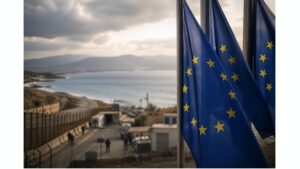
Photo: depositphotos.com/ ChatGPT