
The Azerbaijani–Hungarian Academic Ties
Vasif Huseynov heads the Western Studies Department at the Baku-based Center of Analysis of International Relations (AIR Center). Since its establishment in 2019, this think tank has been a defining actor in Azerbaijani foreign policy, writing analytical reports for the government of Azerbaijan. Huseynov’s research focuses on the complex security policy of the South Caucasus and the strategic, energy-based and logistical, relations between Azerbaijan and the European Union. In the following interview, conducted during his visit to Budapest, we discussed the possibilities of bilateral cooperation, the geopolitical constraints facing the region, the significance of the integration of the Turkic world, the future prospects of academic diplomacy, and the strategic importance of the “Middle Corridor” in modern Eurasian connectivity.
Let’s start with a short introduction: what is your field of research in your daily work?
I lead the Western Studies Department at the AIR Center, which works closely with the presidential administration. Since 2019, I have been researching Azerbaijan–EU relations and security issues in the South Caucasus. I earned my PhD in Germany in 2018; time flies, but this area of research remains central to my work. For us, research is not an isolated, theoretical activity, but a mission to support daily diplomatic and strategic decision-making. My task is to analyse global trends affecting the relationship between Azerbaijan and the West, whether in security policy, energy, or diplomatic dialogue. In my daily life, I must constantly synthesize scientific research with realpolitik interests.
How significant is the European Union for Azerbaijan today?
The European Union is not just a trading bloc; it is an indispensable, strategic partner for Azerbaijan. More than half of Azerbaijan’s total trade turnover is linked to the Union, which is an incredibly high ratio. We are a significant natural gas exporter: ten member states currently buy gas from us, and as of this January, Germany and Austria have also joined this group. Our long-term goal is to expand the network and significantly increase volumes, potentially reaching Ukraine, Moldova, or even Poland. Beyond the energy sector, broader economic cooperation is also paramount, as the influx of EU technologies, know-how required for the transition to sustainable energy, and capital is fundamental to the long-term modernization of our economy.
What role do universities play in this partnership?
The role of universities is critical in people-to-people diplomacy. Relations at the level of political leadership can be excellent, but without strong societal foundations, these agreements do not become sustainable or operable in the long run. The Hungarian–Azerbaijani relationship is exemplary here: under Viktor Orbán’s governance, the relationship has deepened significantly. Hungary offers hundreds of scholarships to Azerbaijani students annually, who become ambassadors of friendship upon returning home, fostering a deeper understanding between the two nations. My wife also studied in Budapest ten years ago, and her experiences remain defining for her. Such exchange programs and academic collaborations, like those we see at Ludovika, are essential for profound strategic cooperation. The academic sphere forms a bridge between the political elite and the citizens.
You have visited Budapest many times. What is your relationship with the city and local institutions?
I first visited in 2013 for a CEU conference, and this is my sixth time back. I first visited Ludovika last year for a conference on the integration of the Turkic world. Ludovika is a very active and visible player in the professional dialogue between our countries. Meeting with students today is always inspiring, as future leaders often build on their student experiences. I am always captivated by the intellectual atmosphere of Budapest, and I am pleased to see how open the local academic community is toward the Caucasus and Turkic regions. Budapest is the European city that has become one of the most important meeting points for intellectual dialogue between East and West in recent years.
What advice would you give to students interested in the Turkic world?
Travel. Those who travel see more than those who just read. Students must see Azerbaijan and other Turkic states with their own eyes and meet local experts, policymakers, and ordinary people. Azerbaijan is not only supplying gas but will soon transport electricity under the Black Sea through Romania and Bulgaria to Hungary. Understanding the Turkic world and building ties with these countries is one of the most important diplomatic and economic tasks of the future, which can truly be learned only through personal presence, not from books. The Turkic world holds not only cultural roots but also vast economic potential, which can only be exploited by professionals who know the specifics of the region.
As a defense expert, how do you see regional tensions, particularly regarding Iran?
Azerbaijan is located in the neighbourhood of Russia and Iran, which is historically a delicate and unstable environment. For us, the top priority is the maintenance of sovereignty and territorial integrity. We have made it clear: no country can use our territory against Iran. However, our relationship with Iran fluctuates; the Iranian Revolutionary Guard often criticizes our close economic and security cooperation with Israel. We do not want to be dragged into this conflict; we wish Iran peace and security, as we know the destructive effect of war. The situation with our diaspora is similar: just as Hungary has many ethnic Hungarians living in Romania and Slovakia, Azerbaijan also has about 20 million of our compatriots living in Iran. While they are connected to the historic region of South Azerbaijan, we respect Iran’s territorial integrity and do not interfere in their internal affairs; we only advocate for the respect of their human and linguistic rights in every forum.
How do you see the future geopolitical prospects, particularly regarding the Middle Corridor?
The “Middle Corridor” will be a key element of our future. It is the only land transport route between the European Union and Asia that does not touch the territory of Russia or Iran. Since this route passes through Azerbaijan, our relationship with the EU is increasingly valuable geopolitically. This logistical fact fundamentally shapes our future cooperation. Despite the challenges, I am confident that regional stability will continue to strengthen, and Azerbaijan can elevate its role as a bridge between Europe and Asia to even higher levels. A stable, secure, and connected region is in the interest of both Azerbaijan and Europe.
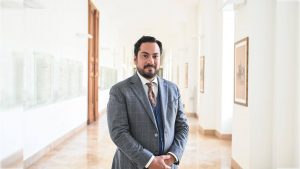
Cover photo: Vasif Huseynov, source: Dénes Szilágyi, LUPS