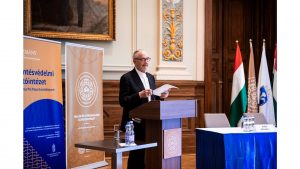

Africa is often spoken about, but far less often spoken with. In the new multi-year academic research programme of the Research Institute for Religion and Society at the Ludovika University of Public Service (LUPS), a conscious effort is being made to reverse this perspective. One of the key contributors to the programme is Fr Richard Baafi, a Ghanaian-born Hungarian Catholic priest and researcher, who brings an insider’s view shaped by African experience and Central European academic training. In this interview, he speaks about Christianity in Africa, the social role of the Church, governance, environmental challenges and why Europe may have something to learn from Africa.
You are involved in a research programme on Christianity and society in Africa. What is your role in this project?
Africa has been studied from many different angles for decades, but very often these studies were conducted from the outside. Researchers inevitably interpret realities through their own cultural lenses. My role in this research is to contribute an internal perspective: to present Africa as it is, without hidden agendas or pressure to conform to predetermined conclusions. The project examines ecological sustainability, governance, peace and conflict, migration and the role of the Church. As an African trained primarily in Africa, but with doctoral studies completed in Hungary, I try to integrate these experiences and interpret African realities from within the cultural context. This also means approaching African realities without preconceived outcomes. Research, in my view, must not be driven by the desire to confirm external expectations. My task is to present Africa “as it is, in its lived reality”, without malice, without hidden agendas, and without pressure to align with certain narratives simply to fit global frameworks. Only then can dialogue between Africa and Europe become genuinely reciprocal.

Language seems to play an important role in this approach.
Absolutely. Africa is linguistically extremely pluralistic, with hundreds of languages and thousands of dialects. While colonial languages such as English, French or Portuguese remain important, indigenous languages are key to understanding societies. I personally speak more than ten African languages, in addition to English and French. Language creates trust. When people can express themselves in their own language, you gain access to deeper realities. An interpreter may transmit words, but meaning, nuance and social context can easily be lost. Being part of the cultural system also matters. When a researcher belongs to the community, has grown within it, and later acquires academic training, this creates both sociability and legitimacy. People are more open, more honest, and more willing to share sensitive experiences. This depth of access is essential when researching issues such as governance, conflict, migration or environmental degradation.
You are also a Catholic priest. Is priestly formation different in Africa than in Europe?
The Catholic Church is universal, and from a canonical perspective, priestly formation follows the same principles everywhere. However, the process is very rigorous and demanding. Formation is not only about education, but about long-term discernment. In my case, the process took twelve years, starting from minor seminary through philosophy, theology and pastoral work, with evaluations at every stage. Psychological, spiritual and academic suitability are all assessed. The laity is also involved in evaluating whether a candidate is fit for ministry. I was ordained in Ghana in 2007 and have been a priest for 19 years. For the past decade, I have served the English-speaking Catholic community at St Stephen’s Basilica in Budapest, which reflects the universal nature of the Church. Priests are ordained for a particular diocese, but at the same time for the universal Church. This means that ministry is not limited by geography. Serving in Budapest while being formed in Ghana is not a contradiction; it is an expression of the Catholic Church as a global community, where pastoral responsibility extends beyond national or cultural borders.
In Africa, the Church often has a broader social role than in Europe. Is that correct?
Yes. The Church is not only a religious institution; it is also a social actor. It establishes schools and hospitals, engages in peace mediation, and often acts as a moral voice holding governments accountable. By promoting values such as honesty, probity, accountability, and social cohesion, the Church contributes to strengthening state institutions. Preaching the Gospel also means promoting transformation of behaviour and social responsibility. The Church operates within society, and its members are also citizens of the state. By forming consciences and promoting ethical values, the Church indirectly contributes to the strengthening of public institutions. When individuals shaped by these values assume public office, they carry principles of accountability, probity and service into governance structures. In this sense, the Church contributes to social development and the moral fabric of the state.
How do you see Africa’s future? Should it follow Western models?
Africa is unique, and I firmly believe that the future of humanity is closely linked to Africa. Many of Africa’s limitations are structurally imposed. If Africans are allowed to define their own paths, things could be done differently. The future lies in strengthening education, renewing mindsets and rediscovering cultural values such as integrity, hard work and innovation. Christianity itself is not foreign to Africa; it has deep historical roots going back to early monasticism in North Africa.
What are the most urgent challenges Africa faces today?
I would highlight three main issues. First, governance: protecting the common good, ensuring accountability and fair distribution of resources. Second, environmental destruction, especially through illegal mining, which leads to health, economic and security crises. Third, religious extremism, particularly in the Sahel region, has caused immense human suffering, displacement and instability. Addressing these challenges would significantly improve peace, security and development. These challenges are not abstract. In West Africa and the Sahel region, extremist violence has spread from one country to another, leading to massive displacement. Communities are under pressure, national budgets are increasingly directed towards security, and development priorities suffer. Environmental destruction and conflict reinforce each other, creating cycles that are difficult to break without coordinated social, political and educational responses.
Is there anything you would particularly emphasise for Europe?
Education is fundamental. It is not only about knowledge, but about shaping behaviour. Without strong education systems, sustainable transformation is impossible. Equally important are family values. The family is the first school of every human being. Societies that strengthen families strengthen social cohesion. In this respect, Europe—and Hungary in particular—has important experiences worth reflecting on. In this sense, education must be understood as formation, not merely instruction. It shapes cognitive abilities, attitudes, and behaviours, as well as empowers individuals with ways of resolving some human-inflicted crises, such as conflict. Equally, family values are foundational. The family is the first school where peace, accountability and coexistence are learned. Societies that protect and empower families create citizens who are less inclined to resort to violence and more capable of living together in diversity.
Invitation to African Ecological Mapping Conference, Thursday 28th May 2026.
I respectfully invite you to the African Ecological Mapping Conference to be held at Ludovika University of Public Service, Budapest, on Thursday, 28th May 2026, from 9:30–15:00 at Ludovika Wing Building, John Lukacs Lounge. The conference will also officially launch the African Ecological Sustainability Mapping research initiative.
Photo credit: byzancephotos / depositphotos.com