



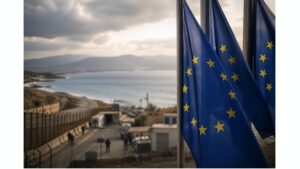




NATO Turning to Undersea Security
The Mediterranean is one of the world’s most strategically important maritime regions, bridging three continents and bordering twenty-one countries. About 30% of global sea-borne trade flows through its waters, including roughly 65% of Western Europe’s oil and natural gas. The undersea cables carry the vast majority of the world’s internet traffic, gas pipelines, and offshore energy platforms that support global commerce, communication, and energy supply to the rest of the world.
The Mediterranean is also a space of enduring fragility. It sits at the crossroads of regions marked by prolonged conflict and instability, from Libya and Syria to parts of the Sahel, and it continues to be the world’s deadliest migration route.
At the same time, it is increasingly a space of great power competition. Russia maintains a significant naval presence through its base in Tartus, Syria, while energy discoveries in the Eastern Mediterranean have intensified rivalries among coastal states and outside actors. As highlighted during a NATO meeting in Rome in November 2025, “threats and challenges are interconnected”. Nowhere is this more evident than in the Mediterranean.
From Counterterrorism to Comprehensive Security: Two NATO Missions
NATO’s sustained engagement with Mediterranean maritime security began formally after the September 11, 2001 attacks. Invoking Article 5 of the Washington Treaty for the first time in Alliance history, NATO launched Operation Active Endeavour (2001-2016), a counterterrorism mission focused on monitoring shipping lanes, escorting commercial vessels through the Strait of Gibraltar, and deterring terrorist movement across the sea.
By 2016, the situation had changed and terrorism was no longer the only concern. Irregular migration, weapons proliferation, and a broader range of hybrid risks also emerged and proliferated. In November 2016, NATO replaced Active Endeavour with Operation Sea Guardian, a non-Article 5 mission with three core tasks: building a shared real-time maritime picture among allies and partners; supporting counter-terrorism operations at sea; and helping partner countries develop their own maritime security capacities.
Unlike its predecessor, Sea Guardian allows non-NATO countries to contribute as operational partners, and the mission also coordinates with the EU-led Operation EUNAVFOR MED IRINI.
Undersea Infrastructure: The New Frontline
In recent years, NATO’s Mediterranean agenda has expanded into the security of critical undersea infrastructure. This includes subsea internet cables (which carry approximately 95 per cent of global internet traffic), gas pipelines linking North Africa and the Eastern Mediterranean to European markets, offshore energy platforms, and the shipping routes that connect them.
The shift followed the sabotage of the Nord Stream pipelines in the Baltic Sea. In response to the rising challenges to undersea infrastructure, NATO set up the Critical Undersea Infrastructure (CUI) Network in February 2024. In November 2025, the Network met in Rome, Italy for the first time including NATO partner nations alongside allied governments, EU representatives, and private industry stakeholders to discuss threats to underwater infrastructure, which is crucial for energy, communications, and security. Deploying sensing and surveillance technologies, including drones, to enhance security around this expanding and increasingly vital infrastructure was a key theme of the meeting. Participants also visited the Italian Navy’s Critical Undersea Infrastructure Surveillance Centre, a facility dedicated to integrated civilian-military monitoring and rapid response.
Behind this sits strategic competition with Russia, whose naval presence in the Mediterranean has grown considerably since 2015, with surface patrols, submarine activity, and intelligence-gathering vessels creating a persistent footprint that NATO monitors closely.
Energy security adds another dimension. Europe’s post-2022 reorientation away from Russian gas has placed new strategic weight on Mediterranean supply routes from Algeria, Libya, and emerging Eastern Mediterranean fields. Protecting these routes is now central to European energy sovereignty. And digital threats are now as serious as physical ones. If undersea cables are damaged, it can disrupt communications during a crisis, making it much harder for countries and organizations to respond effectively.
The Mediterranean Matters, More than Ever
The Mediterranean is not a peripheral space in European security policy, it is increasingly central to it. Energy routes, undersea cables, migration corridors, the EU’s carbon trade policies through Carbon Border Adjustment Mechanism (CBAM), and the New Pact for the Mediterranean all intersect in the Mediterranean. In the Mediterranean, strategy, security, and cooperation are inseparable, and what happens there will shape the future of Europe.
Photo credit: AI Generated